AOC vs DAC: A Comprehensive Technical Guide to Selecting Active Optical Cables for Modern AI & HPC Fabrics
John
Active Optical Cable (AOC): The Core Interconnect for High-Speed Networking
A comprehensive technical guide to AOCs for data centers, HPC, and AI clusters (~2000 words, with image placeholders)
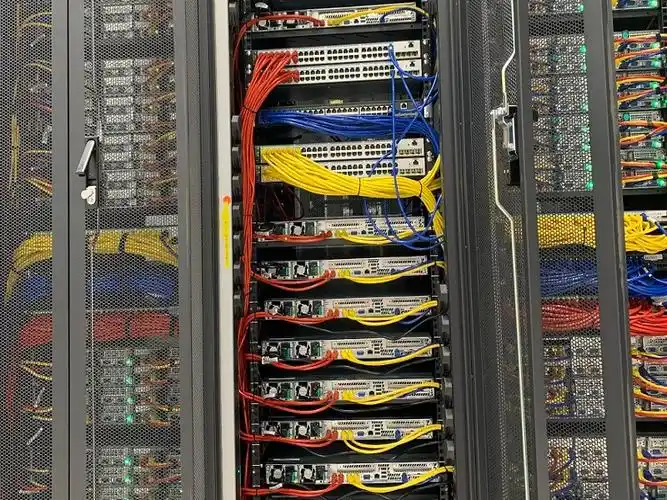
Figure 1: Large-scale deployment of Active Optical Cables in a modern hyperscale data center.
1. What Is an Active Optical Cable (AOC)?
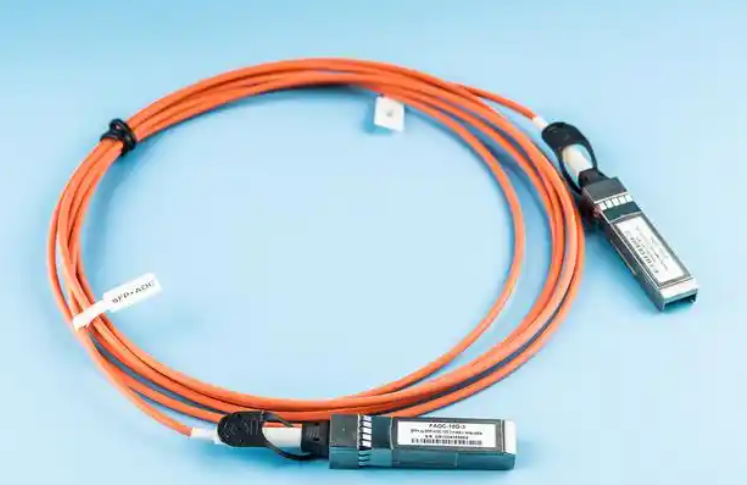
An Active Optical Cable (AOC) is a fiber-optic cable assembly with optical transceivers permanently embedded in both ends. It converts the traditional two-step connection—pluggable module + fiber patch cable—into a single, factory-terminated, plug-and-play assembly.
Each end of the cable contains a miniaturized optical engine that typically includes:
A VCSEL laser (850 nm multimode light source)
A laser driver IC
A Trans-Impedance Amplifier (TIA)
A DSP / CDR for signal conditioning
An MCU for diagnostics and control
AOCs usually employ OM3 or OM4 multimode fiber as the transmission medium. Data is converted from electrical signals to optical pulses, transmitted through the fiber, and converted back to electrical signals at the far end. The result is a high-speed, lightweight, EMI-immune interconnect.
Figure 2: Internal block diagram of an AOC — electrical signal → driver → VCSEL → fiber → photodiode / TIA → electrical signal.
2. AOC vs. DAC: Why Choose AOC?
In short-reach interconnects, AOCs are most often compared with Direct Attach Copper (DAC) cables. The table below highlights their key differences:
Specification
DAC (Direct Attach Copper)
AOC (Active Optical Cable)
Max Data Rate
Limited at 100G; viable at 400G for very short runs
10G to 800G+ fully covered
Reach
≤ 3 m @ 100G, ≤ 2 m @ 400G
Up to 100 m over OM4
Weight
Heavy, large bend radius
~1/4 the weight of equivalent DAC
Heat Dissipation
High
Low, switch-friendly
EMI Immunity
Weak
Excellent (optical signal is non-conductive)
Cost per Port
Low
Moderate
Bottom line: Once speed reaches 100G and distance exceeds ~5 m, AOC wins on performance, density, and operability. That is why, from the 200G era onward, AOCs have become the de facto choice for ToR–Leaf links in data centers.
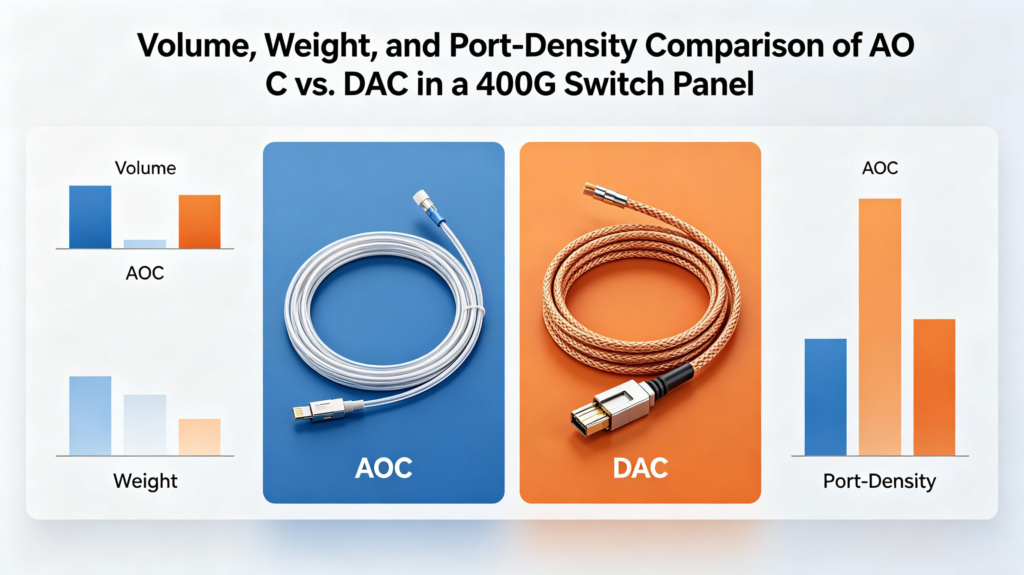
Figure 3: Volume, weight, and port-density comparison of AOC vs. DAC in a 400G switch panel.
3. Speed Evolution: From 10G to 800G
AOC speeds have evolved in lockstep with Ethernet standards:
10G SFP+ AOC — the first mainstream AOC, used inside server racks for ToR connectivity.
25G SFP28 AOC — driven by the rise of white-box cloud servers; still widely deployed.
40G QSFP+ AOC — 4 × 10G lanes, covering 1 m to 100 m.
100G QSFP28 AOC — 4 × 25G lanes, the workhorse of previous-generation AI clusters.
200G QSFP56 AOC — 4 × 50G PAM4; a transition option for hyperscalers.
400G QSFP-DD / OSFP AOC — 8 × 50G PAM4, the core of modern AI and HPC fabrics.
800G OSFP / QSFP-DD800 AOC — 8 × 100G PAM4, scaling in production since 2024.
1.6T (in development) — targeting the 2026–2027 generation of AI fabrics.
💡 Key insight: From 400G onward, AOCs almost universally adopt PAM4 (4-level Pulse Amplitude Modulation) combined with DSP-based signal processing to maintain spectral efficiency and bit-error-rate (BER) performance.
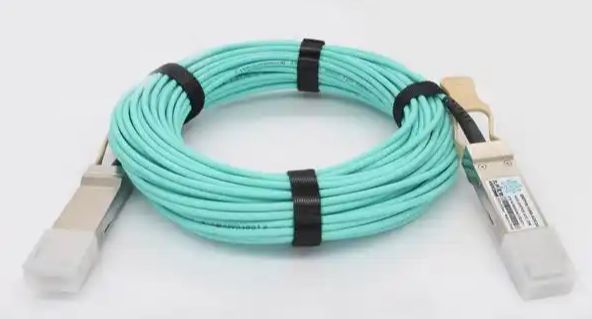
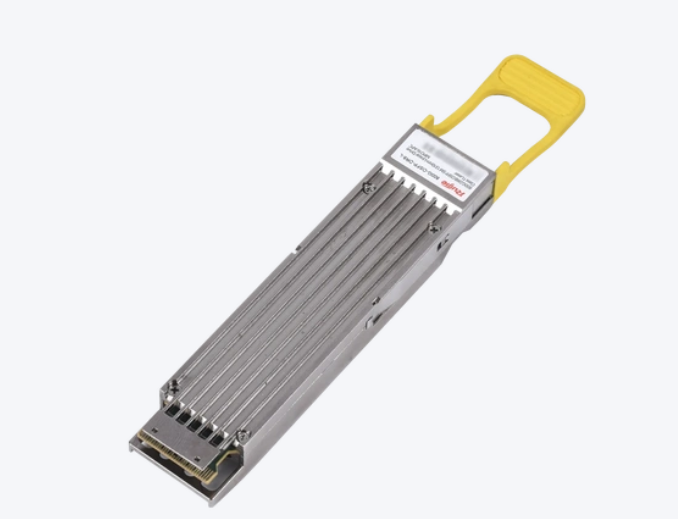
Figure 4: 800G QSFP-DD800 AOC — heat-sink fin design supports hot-swap in high-density switches.
4. Core Application Scenarios
4.1 Cloud and Hyperscale Data Centers
AOCs connect servers ↔ ToR switches and leaf ↔ spine switches. A single 1U, 32-port 400G switch can fan out 32 AOCs from one faceplate without crowding or thermal issues.
4.2 AI Training Clusters (GPU / TPU Fabrics)
In NVIDIA NVL, InfiniBand NDR/HDR, and similar AI fabrics, 400G / 800G AOCs are the preferred interconnect media for GPU nodes. Compared to DAC, AOCs offer:
Longer reach (≥ 5 m between GPU cabinets is common)
Higher density
Lower bit-error rate (BER)
— all of which are critical to keep large-model training runs stable.
4.3 High-Performance Computing (HPC)
HPC clusters demand deterministic latency and high throughput. Because AOCs deliver a stable, predictable electrical-to-optical conversion path, they are the dominant link media in InfiniBand HDR/NDR systems.
4.4 5G Fronthaul / Midhaul
Some 5G mobile fronthaul deployments use 25G / 100G AOCs to replace legacy CPRI solutions, lowering CAPEX for operators.
Figure 5: Typical 400G/800G AOC cabling pattern on the back of an AI training rack (DGX SuperPOD-style).
5. Key Technical Specifications to Evaluate
When sourcing or qualifying AOCs, pay close attention to:
Data rate and protocol — IEEE 802.3, QSFP-DD MSA, OSFP MSA, CMIS compliance.
Reach — common lengths: 3 / 5 / 10 / 30 / 50 / 100 m.
Optical power budget — Tx power, Rx sensitivity, extinction ratio.
BER — pre-FEC BER typically ≤ 1E-6 or 1E-8.
Power consumption — a 400G AOC usually draws ≤ 10 W per end.
Operating temperature — commercial 0–70 °C, industrial -40–85 °C.
Diagnostics — DDM/DOM, CMIS 4.0.
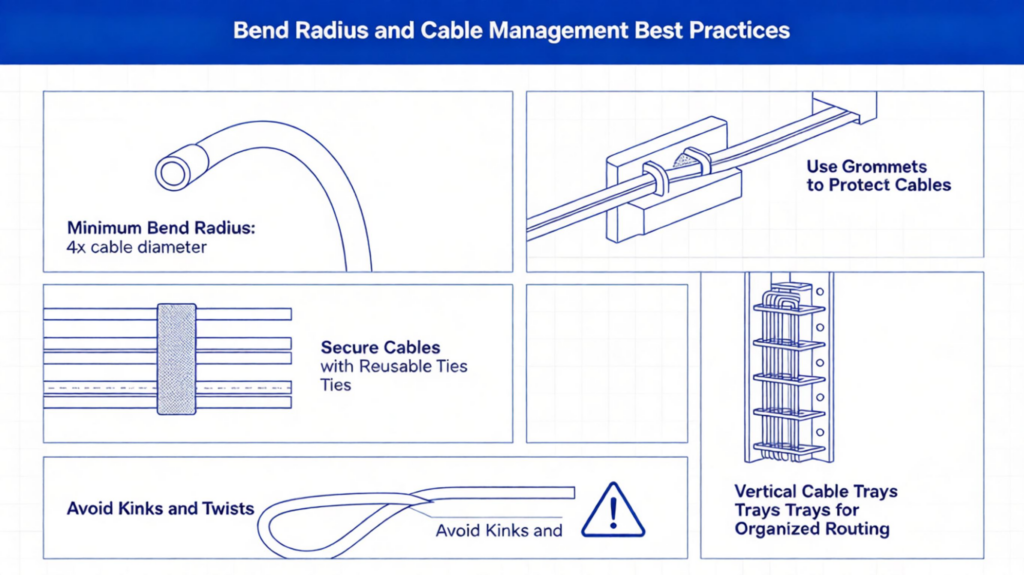
Bend radius — typically ≥ 30 mm (tighter for OM4 fibers).
Flame rating — OFNR / OFNP / LSZH to meet data-center fire codes.
6. Seven Practical Tips for Selection and Deployment
Lock down the protocol stack. AOCs must exactly match the protocol of the switch/NIC — 400G DR4 ≠ 400G FR4 ≠ 400G SR4.
Never mix MSA form factors. QSFP-DD and OSFP are physically incompatible; mismatches can damage cages.
Add length headroom. Real paths include cable trays and overhead jumpers — order length = physical distance × 1.2.
Mind the airflow. In dense AOC deployments, front-to-back airflow must align with the switch fan direction.
Prefer certified vendors. Choose suppliers whose modules are validated against major switch platforms (Arista, Cisco, NVIDIA/Mellanox, H3C, Huawei).
Label everything. Every AOC should carry a unique QR/barcode label for CMDB and troubleshooting.
Test before commissioning. Use an optical power meter and BERT to spot-check (recommended sampling rate: ~5%) before going live.
Figure 6: Recommended bend radius (≥ 30 mm) and overhead cable-tray management for AOCs.
7. Future Trends: 1.6T, LPO, and CPO
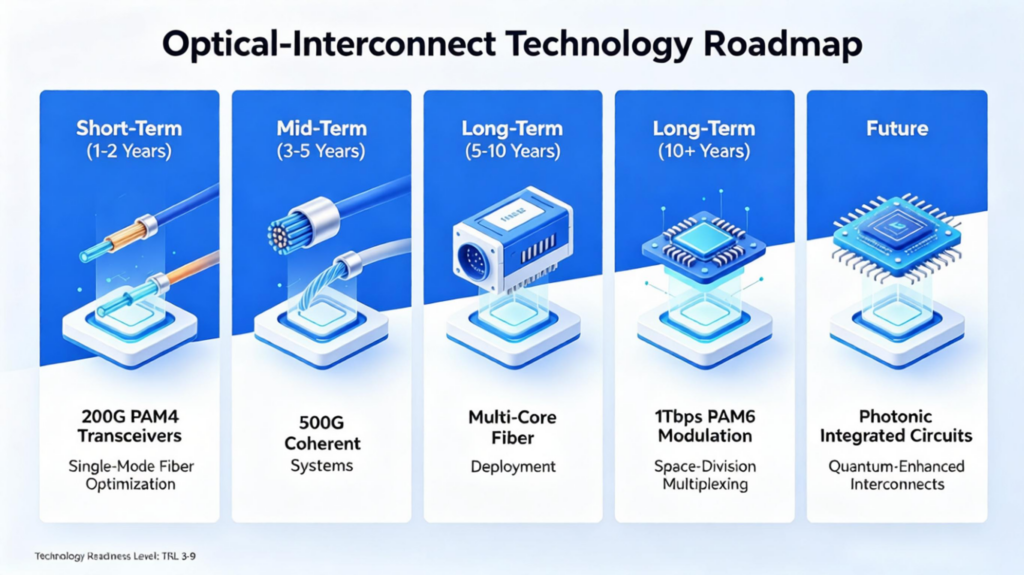
1.6T AOCs: With 200G SerDes emerging, 1.6T OSFP AOCs will enter AI fabrics in 2026–2027.
LPO (Linear Pluggable Optics): Removes the DSP, cutting power by up to 50%. Pilot deployments began in 2025 — a lightweight variant of AOC.
CPO (Co-Packaged Optics): Integrates the optical engine directly with the switch ASIC, promising another 30%+ power reduction. Ecosystem still maturing; expected commercial ramp after 2027.
Silicon Photonics: Future AOCs will increasingly use SiPh processes to shrink size and reduce cost.
The Active Optical Cable has quietly evolved from an “invisible cable inside a rack” into a foundational physical layer for AI-era data centers and compute fabrics. By leveraging the low loss and EMI immunity of optical fiber, AOCs deliver the high density, high speed, and high reliability that modern networks demand.
For engineers building AI training clusters, upgrading to 400G/800G fabrics, or optimizing cloud data-center cabling, understanding how AOCs work, how their specs are evolving, and how to choose and deploy them correctly is the first step to avoiding costly mistakes and maximizing ROI.