Cat5e vs Cat6 vs Cat6a vs Cat7 vs Cat8: A Factory Engineer’s Buyer’s Guide to Commercial Ethernet Cabling
Most cabling guides tell you what to install. This one tells you what to buy — and the difference matters. Whether you’re a procurement manager for a system integrator, an IT distributor stocking inventory, or a B2B project owner running a 10-floor office build, the wrong Ethernet category is a 5- to 15-year sunk cost hidden behind a ceiling tile.
I’ve spent 11 years on the factory side of that decision — first as a production engineer at OWIRE’s Huizhou plant, now as the lead of the OEM/ODM applications team. This guide is what I wish every buyer brought to the table before signing a Cat6a purchase order. It includes the actual model numbers we ship (from the 2025 OWIRE Network Cable Catalogue), the real per-reel test limits we certify against, and the questions that reveal whether your supplier is actually a manufacturer or a middleman with a price list.
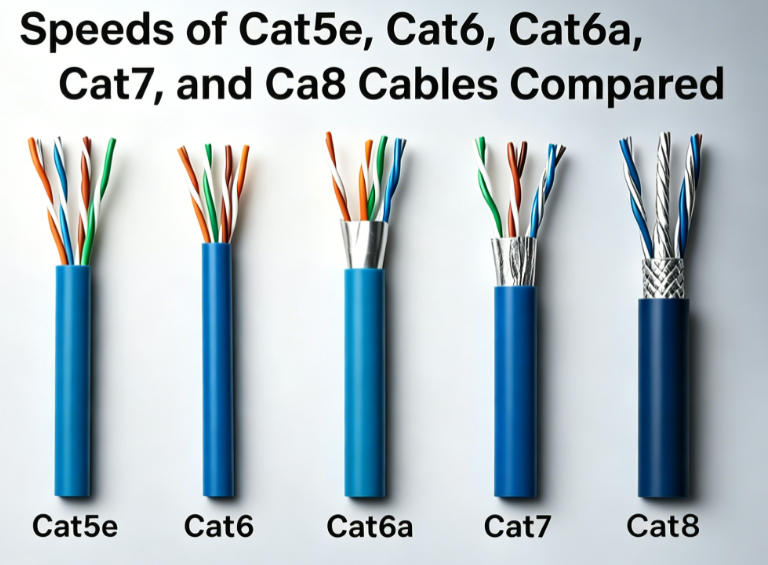
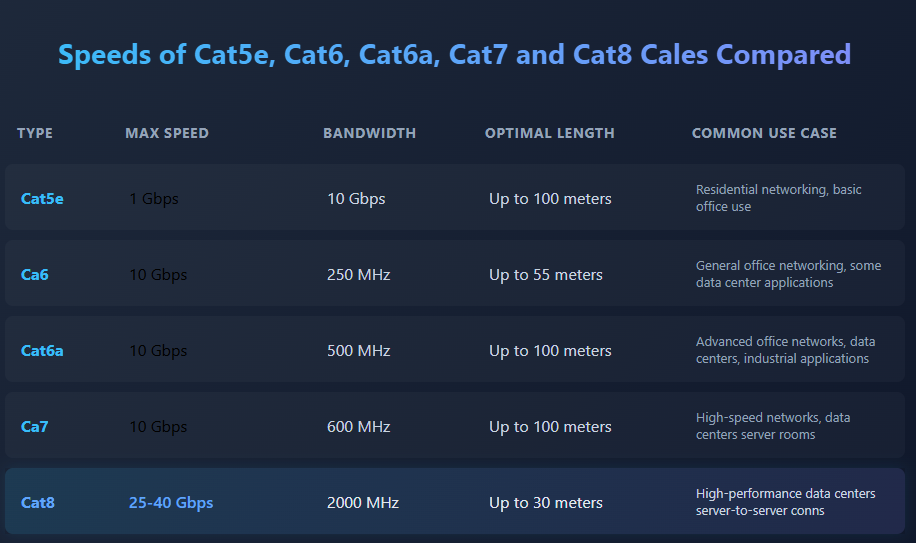
Quick Comparison Matrix (Real Specs, Not Marketing)
| Category | Max Data Rate | Bandwidth | Max Distance (Full Speed) | Conductor (OFC) | Insulation OD | Jacket OD (Indoor) | Common Shielding | OWIRE Model(s) |
|---|---|---|---|---|---|---|---|---|
| Cat5e | 1 Gbps (2.5G short-run) | 100 MHz | 100 m | 24 AWG | 0.90–1.00 mm | 5.10–7.50 mm | U/UTP, F/UTP, SF/UTP | IS9011 / IS9012 / IS9013 / OD9011 / OD9012 / OD9013 |
| Cat6 | 1 Gbps (10G up to 55 m) | 250 MHz | 100 m @ 1G / 55 m @ 10G | 23 AWG | 1.00–1.15 mm | 6.10–7.50 mm | U/UTP, F/UTP, SF/UTP | IS9021 / IS9022 / IS9023 / OD9021 / OS9021 / OD9022 |
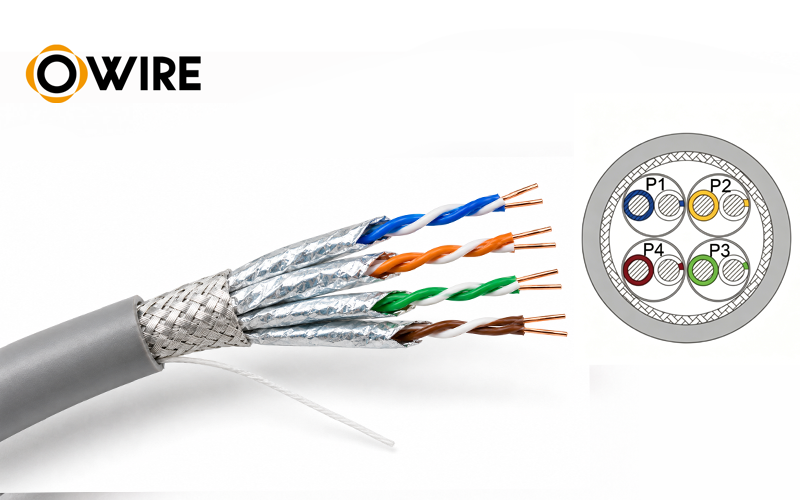
| Cat6a | 10 Gbps | 500 MHz | 100 m | 23 AWG | 1.15 ± 0.08 mm | 7.40–8.60 mm | U/UTP, F/UTP, S/FTP | Cat6A U/UTP / F/UTP / S/FTP series |
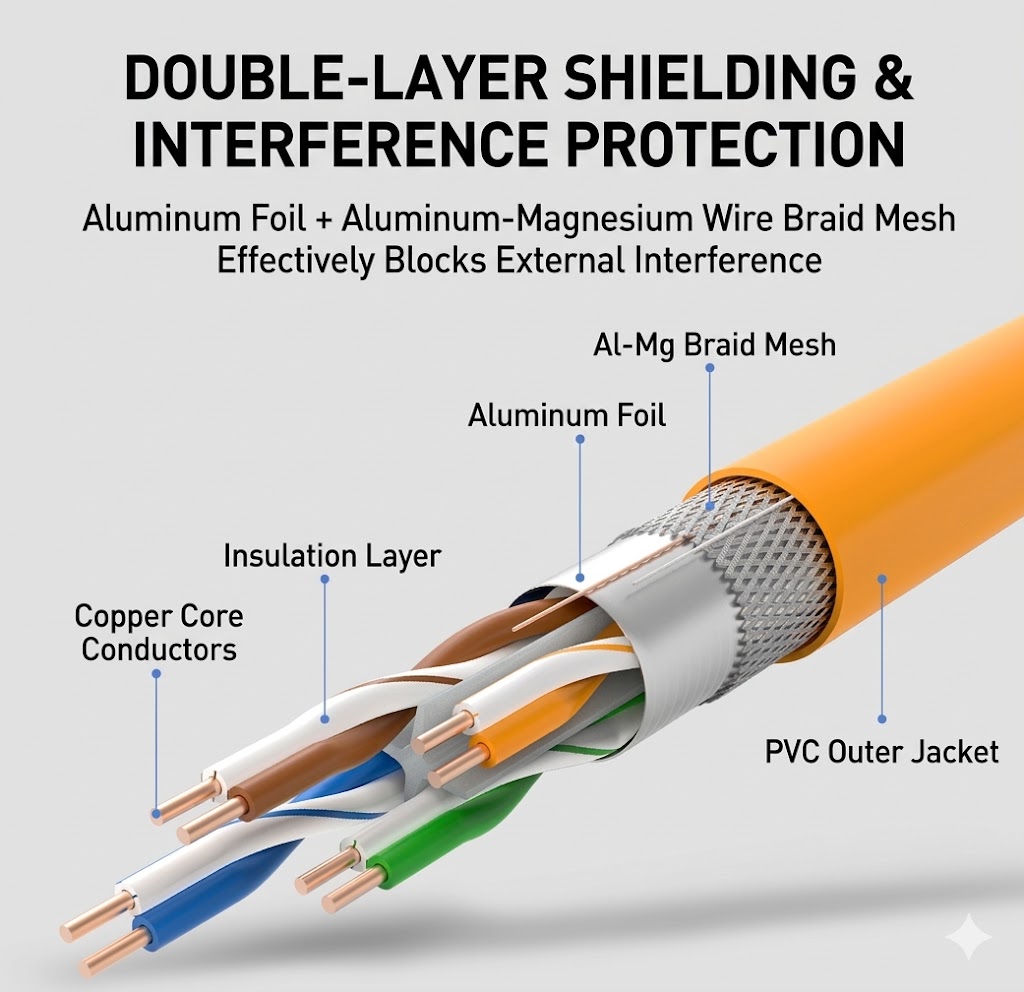
| Cat7 | 10 Gbps | 600 MHz | 100 m | 23 AWG | 1.30 ± 0.05 mm | 8.0–8.5 mm | S/FTP only (Al-mylar + braid) | Cat7 S/FTP series |
| Cat8 | 25 / 40 Gbps | 2,000 MHz | 30 m | 22 AWG | 1.50 ± 0.05 mm | 8.5–9.0 mm | S/FTP only | Cat8 S/FTP series |
All OWIRE indoor cables meet ANSI/TIA 568.2-D, ISO/IEC 11801, YD-T1019, UL444. Operating temperature −10°C to +60°C. Conductor DC resistance: 93.8 Ω/km (Cat5e, 24 AWG) / 73.2 Ω/km (Cat6/6a, 23 AWG). Dielectric strength 1.5 kV AC / 2 s minimum, no breakdown. Working capacitance ≤ 5.6 nF/100 m. Min bend radius 5–8 × OD. Tensile rating 110 N short-term, 20 N long-term.
The Honest Answer: Which Cable Should You Buy?
For a new commercial office build in 2026: Cat6a. Not Cat7, not Cat8. Cat6a.
It runs true 10 Gbps over the full 100-meter channel (Cat6’s 55 m limit silently breaks office runs that route through cable trays). It dissipates heat from PoE++ (IEEE 802.3bt, 90 W) without throttling. It’s the only TIA-recognized standard that covers 10GBASE-T for horizontal runs. And — because Cat6a and Cat6 are now within 10–15% on material cost at the bulk order level — the “save money with Cat6” argument is mostly gone.
The rest of this article explains why, with the actual production-side details that affect what you put in your RFQ.
1. Cat5e — When It Still Makes Sense (and When to Walk Away)
Cat5e was the workhorse of 2000s office networks. It still functions for 1 Gbps point-to-point, supports 2.5GBASE-T up to 100 m, and costs almost the same as Cat6 in 2026.
What the catalogue actually says: OWIRE ships Cat5e in six variants — three indoor (IS9011 U/UTP at 5.10 mm OD, IS9012 F/UTP at 5.80 mm, IS9013 SF/UTP at 6.20 mm) and three outdoor (OD9011 single-jacket PE, OD9012 PVC+PE double sheath at 7.00 mm, OD9013 double sheath SF/UTP at 7.50 mm). All use 24 AWG oxygen-free copper, HDPE insulation, and meet the same TIA 568.2-D spec.
When to buy Cat5e in 2026:
- Repairing or extending a legacy network that already runs Cat5e.
- Short-run applications where 1 Gbps is the ceiling (POS terminals, basic IP cameras, IoT sensors on a 2.4 GHz Wi-Fi backbone).
- Cost-driven retail rollouts where the customer explicitly does not need 10G headroom.
When to walk away from Cat5e:
- Any new commercial build planned to last 10+ years.
- Any deployment that will see PoE++ devices (Wi-Fi 7 APs, PTZ cameras, AV-over-IP endpoints).
- Any environment where the cable will sit behind a fire-rated wall or in a plenum — a future Cat6a re-pull is a 5× cost vs. doing it once.
2. Cat6 — The “55-Meter Trap” Most Buyers Don’t See Coming
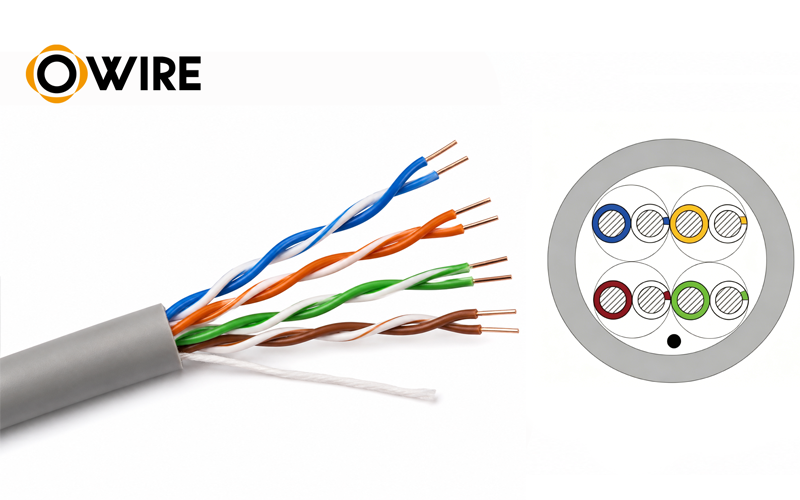
Cat6 doubled bandwidth to 250 MHz by adding a center cross-spline separator to isolate the four pairs. The lab spec is 10 Gbps at 100 m. The field spec is 10 Gbps at 55 m — and the difference matters more than most cabling guides admit.
The trap: the 100 m / 10 Gbps Cat6 rating assumes a controlled lab environment with no alien crosstalk (ANEXT) from adjacent cables. In a real commercial cable tray with 48 cables bundled together, ANEXT pushes the usable 10G distance down to 30–55 m depending on bundle density. Most multi-floor office runs route through trays for 60–90 m. The network silently drops to 1 Gbps — and the only way to catch it is a FLUKE DSX-8000 channel test on every drop.
OWIRE’s Cat6 line (from the 2025 catalogue):
- IS9021 (indoor U/UTP, 6.10 mm OD, PVC or LSZH) — the default for office horizontal runs.
- IS9022 (indoor F/UTP, 7.50 mm, Al-mylar + drain) — for EMI-heavy environments.
- IS9023 (indoor SF/UTP, 7.50 mm, braid + Al-mylar) — for industrial or high-interference zones.
- OD9021 (outdoor SF/UTP, 7.20 mm, PVC+PE double sheath) — for outdoor runs with EMI exposure.
- OD9022 (outdoor F/UTP, 7.40 mm, PE jacket) — for outdoor duct without heavy shielding needs.
When to buy Cat6 in 2026: short-run small offices with verified runs under 45 m and no PoE++ load. That’s it. If your run is longer, or the customer might add Wi-Fi 7 APs in 18 months, step up to Cat6a.
3. Cat6a — The Default Choice for 2026 Commercial Builds
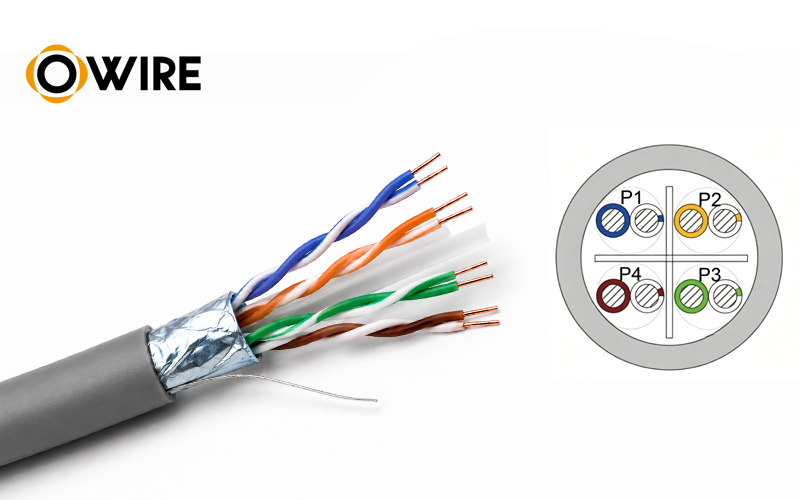
Cat6a was specifically engineered to fix Cat6’s distance and ANEXT problems. 500 MHz bandwidth, full 100 m 10GBASE-T support, individual pair shielding (S/FTP) or thicker jacket engineering (U/UTP) to kill alien crosstalk.
The real engineering reasons Cat6a wins for new builds:
- Heat dissipation. PoE++ pushes 90 W per port. Bundle 24 Cat6a cables in a tray carrying PoE++ and the bundle temperature rises ~10°C above ambient. Cat6a is engineered to dissipate that heat without the dielectric breakdown that fails Cat5e/Cat6 in the same conditions. We see this in field — our QC team has measured jacket temperatures at 62°C on a 24-cable PoE++ bundle with Cat6a, and the cable still certifies. Cat5e at the same bundle density fails at 6 months.
- AV-over-IP and Wi-Fi 7 headroom. Modern conference rooms run AV-over-IP (Dante, SDVoE) and Wi-Fi 7 APs pull 2.5G / 5G / 10G uplinks. Cat6a handles all of it on the same horizontal run. Cat6 bottlenecks the AP uplink to 1G or, at best, 2.5G over 55 m.
- Lifecycle math. The labor cost of pulling cable is now 2–3× the material cost. If you install Cat6 and have to re-pull Cat6a in 5 years, the labor alone wipes out the savings — and you still have the operational disruption of opening ceilings twice.
OWIRE Cat6a SKUs: U/UTP (7.40 mm OD, lower cost, office default), F/UTP (7.50 mm, EMI environments), S/FTP (8.60 mm, high-EMI / data-center edge). All with 23 AWG oxygen-free copper, 1.15 ± 0.08 mm insulation OD, PVC or LSZH jacket.
When to buy Cat6a in 2026: every new commercial office, healthcare facility, school, warehouse, hotel, retail chain rollout, and any deployment that needs to support PoE++ or 10G-capable endpoints for the next 10+ years. Default. No exceptions.
4. Cat7 — The Specification That Misleads Buyers
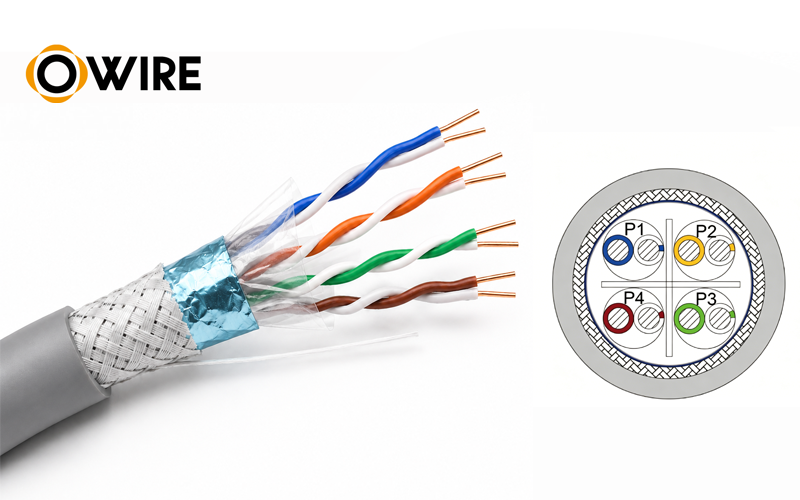
Cat7 looks impressive on a data sheet. 600 MHz bandwidth. Heavy S/FTP shielding. Sounds like a Cat6a upgrade. It isn’t.
Three reasons Cat7 is a trap for most commercial buyers:
- Not a TIA standard. Cat7 is ISO/IEC 11801 Class F, a European standard. It is not recognized by TIA/EIA, the body governing North American commercial cabling. If your customer is in the US, Canada, or any project bid against TIA specs, Cat7 is a non-conforming install. Most low-voltage contractors will refuse to warranty it.
- Proprietary connectors. Cat7 natively uses GG45 or TERA connectors. Most “Cat7” cable sold in North America is terminated with RJ45 plugs — and the moment you do that, the channel is field-certified at Cat6a parameters. You’re paying Cat7 prices for a Cat6a link.
- Cost vs. benefit. The shielding density that gives Cat7 its 600 MHz spec also drives up material cost ~25% over Cat6a, with no real-world performance benefit in commercial office environments.
When to buy Cat7: almost never for a commercial office. It has a niche in extreme-EMI industrial environments (heavy machinery, broadcast studios) where the S/FTP shielding buys you headroom that Cat6a cannot match. If a customer is asking for “Cat7,” they almost certainly mean “shielded Cat6a” — clarify before quoting.
5. Cat8 — The Data-Center Specialist
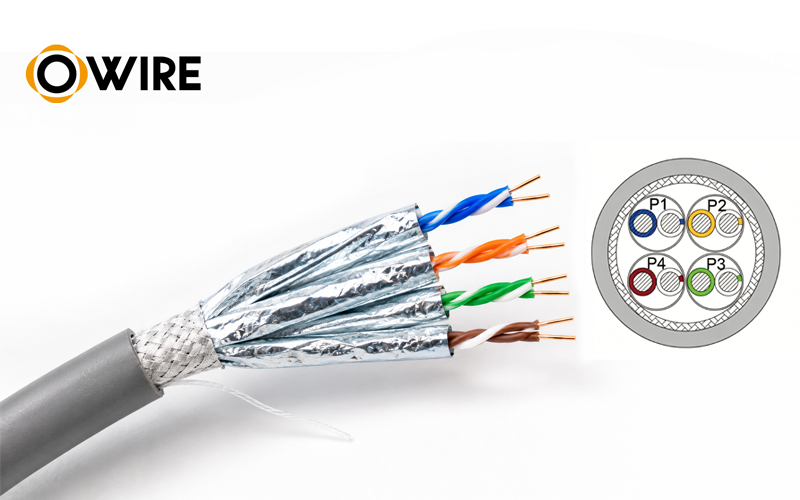
Cat8 is a different animal. 2,000 MHz bandwidth, 25 Gbps and 40 Gbps data rates, but maximum channel length 30 m — not a typo. It is purpose-built for short Top-of-Rack (ToR) switch-to-server interconnects in data centers, where it competes with fiber transceivers and DAC cables.
Why the 30-meter limit: at 2,000 MHz, signal integrity collapses beyond 30 m on twisted-pair copper. No manufacturer can extend this. If someone is selling you “Cat8” with a 50 m or 100 m rating, run — the cable is mislabeled.
OWIRE Cat8 SKUs: S/FTP, 22 AWG oxygen-free copper, 1.50 ± 0.05 mm insulation OD, 8.5–9.0 mm jacket OD. PVC or LSZH jacket options.
When to buy Cat8: server rooms and data centers, period. If a buyer asks for Cat8 for a horizontal office run, they are misinformed. The right answer is Cat6a for the horizontal, Cat8 (or fiber) for the data-center spine.
🏢 Corporate Office / Multi-Tenant Facility
- Recommendation: Cat6a S/FTP or U/UTP (OWIRE Cat6A series, 7.40–8.60 mm OD).
- Why: Future-proofs the physical plant, supports PoE++ and AV-over-IP, certified to TIA-568.2-D.
- Volume / lead time: 1,000+ drops — 15–20 days, peak season 20–25 days.
- Pair with: Cat6A patch cords, keystone jacks, 24/48-port patch panels — all available on the same PO.
🏬 Small Startup / Retail Space (< 20 drops, runs < 45 m)
- Recommendation: Cat6 U/UTP (IS9021, 6.10 mm OD, PVC or LSZH).
- Why: Lowest material cost; 1 Gbps is sufficient for typical retail traffic.
- Caveat: verify every run is under 45 m before pulling. If the building has a long horizontal run to a back-office IDF, step up to Cat6a.
- Volume / lead time: 20–100 drops — 7–10 days, even in peak season.
🎛️ On-Premise Server Room / Data-Center Spine
- Recommendation: Cat8 S/FTP (8.5–9.0 mm OD) for ToR links; Cat6a S/FTP for anything that runs beyond 30 m.
- Why: Cat8 replaces expensive fiber transceivers and stiff DAC cables for short interconnects.
- Volume / lead time: 50–500 drops — 10–15 days.
- Pair with: 24/48-port Cat6A/Cat8 patch panels, MPO/MTP trunks for the 40G/100G backbone.
A Factory-Direct Buyer’s Checklist (5 Questions to Ask Before You Wire the Deposit)
If you’re sourcing commercial Ethernet cable in bulk from any Chinese manufacturer, ask these five questions before you sign a PO. The answers separate a factory from a trading office.
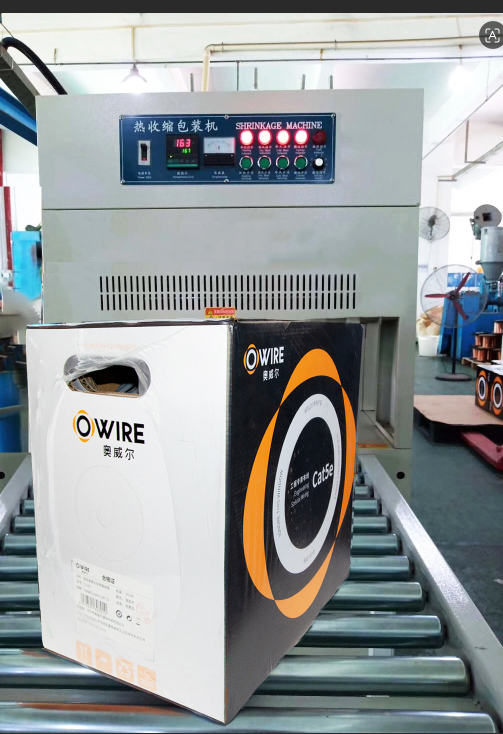
- “What is your monthly LAN cable output in boxes?” A real factory answers with a specific number (OWIRE: 70,000+ boxes/month across 3 production bases). A broker answers with adjectives (“strong capacity”).
- “Send a 2-minute factory-tour video, dated within the last 30 days.” A real factory sends it the same day. A broker says “let me check.”
- “What test equipment certifies the reels?” A real factory names the instruments: FLUKE TDX-1800, HP Agilent E5071C, JDSU OTDR MTS2000. A broker says “we test everything.”
- “What is the lead time on a 1,000-box Cat6a S/FTP order in Q3?” A real factory quotes a number (OWIRE: 18–22 days). A broker says “fast delivery, no worry.”
- “Can you sign an NDA before we share our spec / artwork?” A real factory signs same day. A broker stalls.
We score 5/5 on our own checklist. If your supplier doesn’t, walk away before you wire the deposit.
Field Story: The 8,000-Drop Office Build That Almost Ran Cat6
In late 2024, a system integrator in Eastern Europe quoted an 8,000-drop office build as Cat6. The customer pushed back: “Our Wi-Fi 7 APs are 10G-capable. We don’t want to re-pull in 5 years.” The integrator came to us for a Cat6a second opinion.
Our applications team reviewed the building floor plans and found ~12% of the runs would exceed 55 m through the cable trays — all of them would have silently dropped to 1 Gbps on Cat6. We quoted Cat6a S/FTP at 7.40 mm OD, 23 AWG, 1.15 mm insulation. Material cost difference vs. Cat6: ~$0.08 per meter. Total uplift on 8,000 drops at an average 35 m run: ~$22,400. Re-pull cost of Cat6a over Cat6 in 5 years (labor + ceiling disruption): estimated $180,000+.
The integrator switched to Cat6a. The customer got a 10-year cable plant. The integrator’s project manager sent a one-line email: “This is the first time a Chinese factory engineer actually pushed back on a bad spec. Thank you.”
That is what an OEM/ODM partnership is supposed to look like.
What OWIRE Ships on the Same PO (One Vendor, One Freight, One Warranty)
A commercial cabling project is not just bulk cable. It’s the cable plus the terminations plus the rack hardware. OWIRE runs production lines for the full passive set — and we ship it all on a single PO, with one QC documentation package and one freight booking.
- Bulk LAN cable — Cat5e to Cat8, indoor and outdoor constructions.
- Patch cords — Cat5e / Cat6 / Cat6A / Cat7 / Cat8, UTP and shielded, 1–50 m custom cut.
- Keystone jacks — Cat5e / Cat6 / Cat6A / Cat8, shielded and unshielded.
- Patch panels — 16 / 24 / 48-port, UTP and FTP, with cable management bar.
- RJ45 connectors — 50 µ” gold plating, 750 mating cycles minimum.
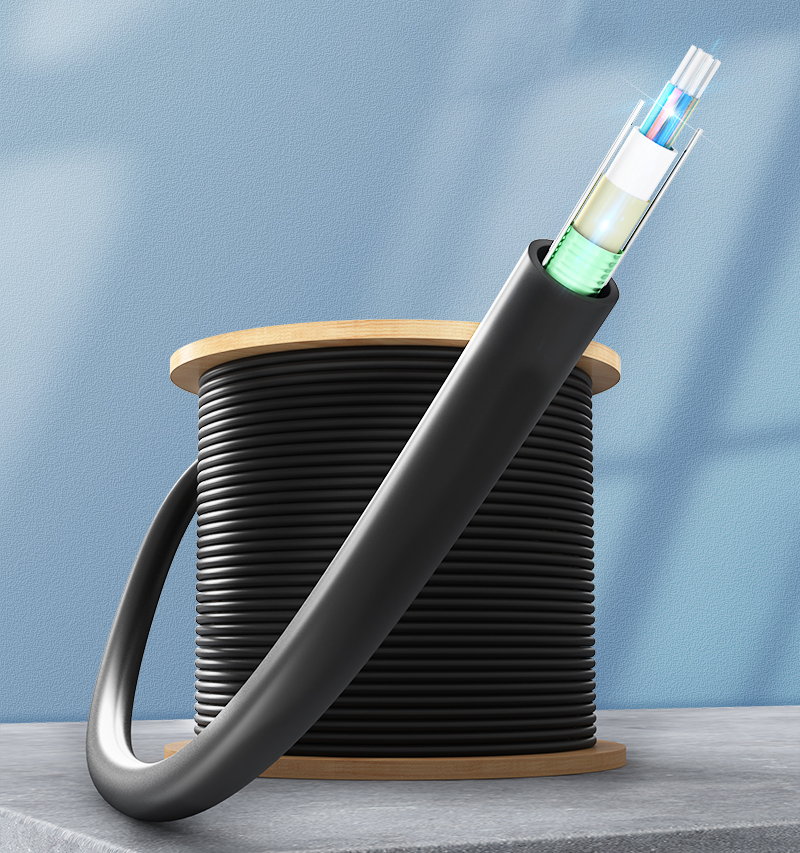
- FTTH drop cable & fiber assemblies — for the backbone, if the project includes it.
- PLC splitters, ODB distribution boxes, splice closures — for the passive optical layer.
Ready to source your next commercial Ethernet cable build direct from the factory? From a 100-drop office to a 10,000-drop campus rollout, OWIRE ships Cat5e–Cat8 LAN cable, Cat6A/Cat7/Cat8 specialty cable, and the full passive set — from one factory, on one PO. Request a per-SKU quotation, an NDA-protected datasheet pack, or a 2-minute factory-tour video today.